
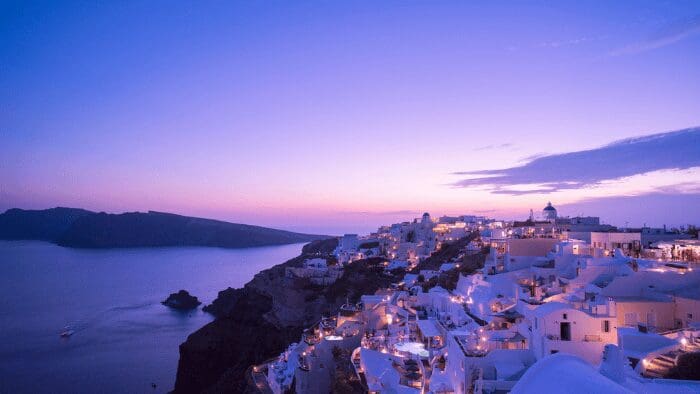
Why Santorini Sunsets Turn the Sky Pink: The Science Behind the Magic
Santorini sunsets are often described as “otherworldly.” People gather hours before sundown, terraces fill across Oia, and cameras point toward the sky waiting for that moment when everything turns pink: soft, glowing, dreamlike.
But here’s the thing:
It’s not magic. It’s science. Beautiful, elegant, simple science.
From volcanic dust to the unique angle of the sun, from the Aegean air currents to the cliffside reflections, Santorini offers one of the most perfect natural laboratories for sunset color.
In this long-form guide, we break down the phenomenon in a way that’s easy, visual, and fun even if you hated physics in school. By the end, you’ll understand exactly why the sky blushes pink in Santorini almost every night… and why watching it from a caldera-view restaurant like Sunsets Santorini makes the experience even more powerful.
Let’s dive in.
Quick Answer
Santorini sunsets turn pink because low angle sunlight travels through more atmosphere, which scatters away blue light and leaves reds and pinks. Clean Aegean air, fine volcanic dust, and light bouncing off the white cliffs deepen the color. It is atmospheric physics, not magic.
1. Why Sunsets Have Color at All (The Simple Version)
To understand what happens in Santorini, let’s start with the basics.
Sunlight is white but it’s made of every color.
When light enters the atmosphere, it interacts with tiny particles: air molecules, dust, water vapor, salt crystals, pollution, volcanic ash, etc.
Each color travels at a different wavelength:
- Blue: short wavelength
- Red: long wavelength
- Pink/orange/yellow: medium-to-long wavelengths
The Rule:
Short wavelengths scatter more easily. Long wavelengths travel farther.
That’s why the sky is blue at midday. The sun is high, and blue light scatters in all directions.
At sunset, the sun is low. Light has to travel through more atmosphere, which filters out the blue and leaves the warmer colors behind.

2. Why Santorini’s Pink Sunsets Are SO Much Stronger Than Elsewhere
Now that you know the basics, let’s talk about what makes Santorini unique.
Santorini isn’t just “anywhere.”
Its sunsets are unusually colorful because the island amplifies all the natural conditions that create pink and red light.
There are five main scientific reasons:
2.1. Volcanic Dust & Minerals Enhance Warm Colors
Santorini’s geology plays a huge role.
The island sits on a volcanic caldera. The air often contains microscopic particles of:
- pumice dust
- volcanic ash
- mineral salts
- sulfur compounds
These particles scatter more blue light, allowing deeper red and pink wavelengths to pass through.
In simple terms:
Volcanic islands = deeper, richer sunset colors.
This is why Hawaii, Bali, Iceland, and Santorini all have famous sunsets.
2.2. The Aegean Sea Creates a “Light Mirror” Effect
The Aegean is incredibly reflective.
On clear days, it acts like a giant mirror that bounces light back toward the sky, intensifying color.
When the sun is low:
- the sea glows gold
- then the water reflects orange
- then it reflects pink
And because Oia faces west across open sea, there are no mountains or clouds blocking the light.
This is why Oia is often ranked the best sunset location in Greece.
2.3. The Clean Aegean Air Makes Colors More Vibrant
Here’s something many travelers don’t know:
Dirty air = dull sunsets
Clean air = bright, saturated sunsets
The Aegean has some of the cleanest air in Europe. Why?
- few industrial emissions
- constant sea winds (the “Meltemi”)
- low humidity
- salt particles instead of pollution particles
Clean air lets warm colors shine through clearly, giving Santorini those soft yet vivid hues.
2.4. Oia’s Cliffside Reflects Sunlight Back into the Sky
This one surprises people.
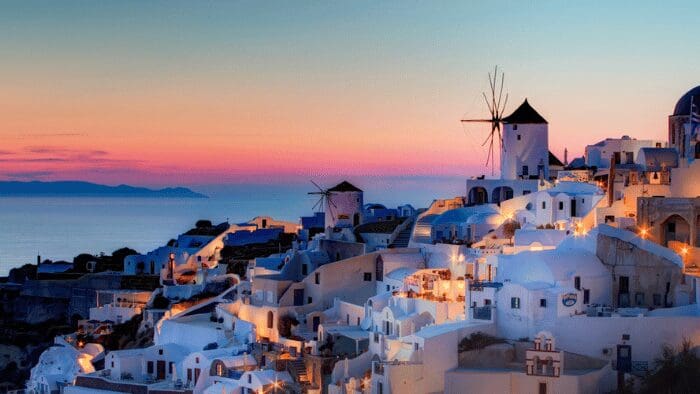
The whitewashed houses of Oia act like natural reflectors.
As the sun lowers, they bounce warm light upward, adding subtle pink and gold tones to the sky.
That means:
- more light
- more warmth
- more color intensity
It’s like the village itself becomes part of the sunset.
2.5. Low Clouds Produce the Famous “Cotton Candy Sky”
Santorini often has thin, low-altitude clouds at sunset, especially in autumn.
These clouds catch the red/pink light from beneath, producing soft “cotton candy” skies that tourists adore.
The science:
Cloud bottoms turn red because the sun illuminates them from below the horizon.
This effect is much rarer in northern Europe or cloudy cities.
3. Why the Sunset Changes Color Minute by Minute
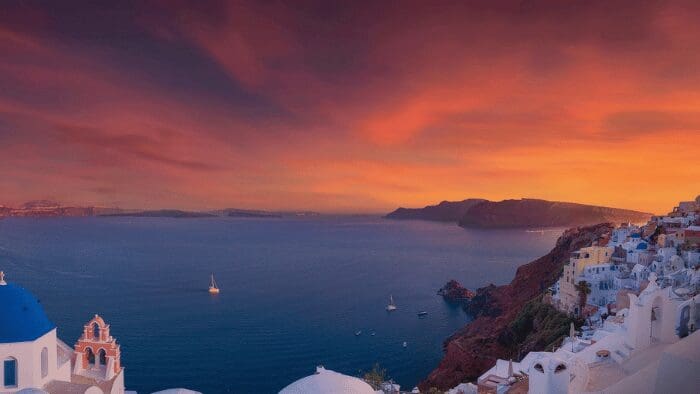
In Santorini, sunset follows a predictable sequence:
Stage 1 – Gold (20–30 minutes before sunset)
Light is strong. Shadows are long.
Great moment for photography.
Stage 2 – Orange (10 minutes before sunset)
Blue light is mostly filtered.
Buildings glow with warmth.
Stage 3 – Pink (exact moment of sunset + 10 minutes after)
This is the iconic Santorini moment.
Volcanic dust + sea reflection = deep pink sky.
Stage 4 – Purple (10–20 minutes after sunset)
The sun is gone, but the atmosphere still glows with long wavelengths.
This stage is called blue hour. Photographers love it.
Stage 5 – Indigo & Night (30+ minutes after)
Stars begin to appear over the caldera.
4. Why Oia Is the “Sunset Capital” of Santorini
Not all parts of the island receive the same sunset.
Oia has:
✔ open ocean horizon
✔ perfect west-facing cliffs
✔ highest elevation points
✔ unobstructed viewing angles
✔ white houses reflecting light
✔ local winds that keep the air clear
Combine these, and Oia becomes a natural amphitheater for sunset.
This is why thousands gather here every evening.
And why cliffside terraces like Sunsets Santorini offer one of the most extraordinary front-row seats to the daily spectacle.
5. When Are Santorini’s Sunsets the Pinkest?
Pink intensity changes by season.
Most Pink Months:
April, May, September, October
Why?
- fewer particles blocking light
- stable weather
- lower humidity
- softer sun angles
Strongest, brightest sunsets:
June – August (longest days, clearest skies)
Most dramatic sunsets:
Autumn (when there are thin clouds)
6. How to Get the Best View of the Sunset (Scientifically Speaking)
To maximize sunset color, look for:
✔ West-facing angle
Your eyes should face directly toward the sun.
✔ Elevated viewpoint
Cliffs intensify horizon glow.
✔ A reflective surface
Sea + white buildings amplify color.
✔ The moment after the sun disappears
This is when pink tones peak.
✔ A location without front obstructions
People, rooftops, and railings block the full gradient.
This is exactly why many travelers choose to enjoy sunset from a caldera-view restaurant, you sit in the perfect scientific position.
At Sunsets Santorini, the terrace at Sunsets Terra is built at one of the highest cliff points in Oia, giving a full 360° view and uninterrupted horizon.
The sky truly becomes part of your dining experience.

7. The Emotion Behind the Science
Science explains the color.
But the reason Santorini sunsets feel special goes beyond molecules and wavelengths.
It’s the slow pace.
It’s the sound of the wind rushing across the cliffs.
It’s the deep silence that falls just before the sun disappears.
It’s the shared moment among strangers.
It’s the glow on white houses, like the village itself is blushing.
And when you’re seated with someone you love: wine, food, and caldera views — the science becomes something deeper.
Something personal.
Something unforgettable.
FAQ
1. Why does the sky turn pink in Santorini?
Because volcanic particles, sea reflections, and clean Aegean air scatter short wavelengths, allowing pink and red hues to dominate.
2. Are Santorini sunsets really different from other places?
Yes. Geography, geology, and climate combine to create stronger, more consistent pink light.
3. What time is the sunset in Oia?
It depends on the season. From 5:00 PM in winter to almost 8:40 PM in July.
4. Where is the best place to watch the sunset in Santorini?
West-facing caldera spots, elevated terraces, and cliffside restaurants offer the most vivid colors.
5. Can you enjoy the sunset without crowds?
Yes. Dinner at a cliffside restaurant like Sunsets Santorini offers a quiet, romantic, unobstructed view.
6. Why do Oia’s white buildings look so golden at sunset?
Because they reflect warm light back into the sky, amplifying the golden-pink glow.