
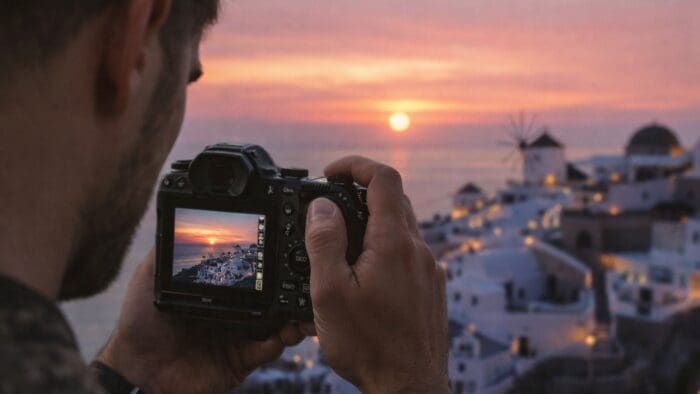
The Santorini sunset is one of the most photographed moments on earth. Golden light spills across volcanic cliffs, whitewashed walls blush pink, and the Aegean turns molten. You have seen it on thousands of Instagram grids, and now you want your own version.
The problem? Most travelers arrive with a camera, a rough idea, and thirty seconds of panic as the sky explodes overhead.
This guide removes the guesswork. Whether you shoot with a mirrorless camera, a DSLR, or a high-end smartphone, you will find the gear recommendations, exposure settings, composition strategies, and location tips to capture a Santorini sunset that goes far beyond the standard postcard.
Understanding Santorini’s Golden Hour
Before you touch your camera, understand the light.
Golden hour in photography refers to the period roughly 45 to 60 minutes before sunset and up to 20 minutes after. During this window, the sun sits low on the horizon, casting warm, diffused light that softens shadows and adds rich amber tones to everything it touches.
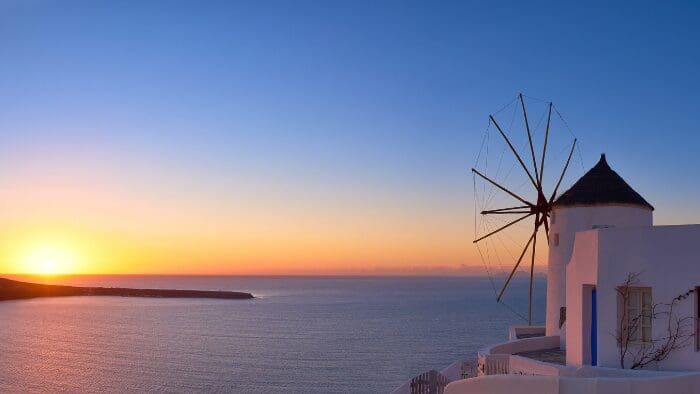
In Santorini, this effect intensifies dramatically. The caldera acts as a natural amphitheater, bouncing light off white plaster, dark lava rock, and the reflective Aegean. The result is a layered palette that shifts from gold to orange to pink to deep violet in under an hour.
Here are the approximate sunset times by season:
- April / May: 7:50 PM to 8:15 PM
- June / July: 8:40 PM to 8:50 PM
- August / September: 8:05 PM to 7:30 PM
- October: 6:45 PM to 6:15 PM
Use TimeandDate.com to get the exact sunset time for your travel dates, then plan to be in position at least one hour before that.
The light changes fastest in the final 15 minutes. Set up before the sky peaks, not during it.
Best Camera Gear for Santorini Sunset Photography
You do not need the most expensive kit. You do need the right kit for the conditions.
Cameras: Mirrorless, DSLR, or Smartphone?
Mirrorless cameras are the top choice for sunset travel photography in 2026. They are lighter than DSLRs, offer excellent dynamic range, and handle the transition from bright sky to dark shadow better than any smartphone. Top options for this style of photography include:
- Sony Alpha 7C II – compact full-frame body with superb dynamic range
- Fujifilm X-T5 – APS-C sensor with outstanding color rendering, great for Santorini’s warm palette
- OM System OM-5 – weather-sealed and compact, ideal for hiking to remote spots
DSLR cameras still deliver excellent results. The Nikon D850 and Canon EOS 5D Mark IV remain outstanding for landscape and sunset work, with large sensors and robust battery life.
Smartphones have closed the gap considerably. The iPhone 16 Pro and Samsung Galaxy S25 Ultra both feature computational HDR and night modes capable of producing stunning sunset images, especially in good light. If your phone is your camera, this guide still applies; just navigate to your camera’s Pro or Manual mode.
Essential Lenses
Lens choice shapes the mood of your Santorini sunset images.
- Wide-angle (16–35mm full-frame equivalent): Captures the full caldera panorama. The Sony FE 16-35mm f/2.8 GM and Tamron 17-28mm f/2.8 are strong picks.
- Standard zoom (24–70mm): The most versatile choice for moving between wide establishing shots and tighter compositions of domes, terraces, and silhouettes.
- Telephoto (70–200mm or 100–400mm): Compresses the scene and pulls the sinking sun into frame alongside Oia’s windmills or blue domes. Produces dramatic, unique images most travelers never attempt.
If you carry one lens, make it a 24–70mm f/2.8. If you carry two, add a 16–35mm for wide caldera shots.
Tripods and Stabilizers
As the sun drops, your shutter speed must slow down. A tripod eliminates camera shake and lets you shoot long-exposure images of the sunset sky and the caldera at twilight.
- Travel tripod: The Peak Design Travel Tripod or Joby GorillaPod 5K balance portability with stability. Santorini’s cobblestone paths and steep steps make weight a real consideration.
- Smartphone gimbal: If shooting with a phone, a DJI OM 7 smooths handheld video and keeps still shots sharp in low light.
Filters: The Sunset Photographer’s Secret Weapon
Filters are underused by travelers and overused by pros. Here is what actually makes a difference for Santorini sunsets:
- Circular Polarizer (CPL): Reduces glare off the sea and deepens the blue sky in the hour before sunset. Leave it on for most of your golden hour shoot.
- Graduated ND Filter (2-stop or 3-stop): Balances the bright sky against the darker caldera below. Without it, your camera either exposes the sky and loses the cliffside, or vice versa.
- Variable ND Filter: Useful for longer exposures during bright pre-sunset conditions, or for shooting video.
Brands like NiSi, Kase, and B+W make high-quality options that avoid color casts.
Accessories Worth Packing
- Extra batteries: Cold Aegean breezes and heavy shooting drain batteries fast. Carry at least two.
- Fast memory cards: Shoot in RAW format and you need cards that write quickly without bottlenecking your burst shooting.
- Lens cleaning cloth: Sea spray and Santorini’s ever-present dust will hit your front element at the worst possible moment.
- Remote shutter release: Eliminates camera shake when shooting long exposures on a tripod.
Camera Settings for the Santorini Sunset
The right settings make the difference between a blown-out sky and a perfectly balanced image.
The Exposure Triangle in Golden Hour Conditions
Understanding ISO, aperture, and shutter speed together is essential. Here is a practical framework:
Starting settings for the first 30 minutes of golden hour:
|
|
|
|
|
|
|
|
|
|
|
|
|
|
|
|
Settings for the final 15 minutes before and after sunset:
|
|
|
|
|
|
|
|
|
|
|
|
|
|
|
|
Bracket your exposures by shooting at -1, 0, and +1 stop. This gives you three frames to blend in post-processing if the dynamic range is too wide for a single shot.
White Balance: Skip Auto During Sunset
Auto White Balance (AWB) often neutralizes the very warm tones that make a Santorini sunset extraordinary. Your camera tries to “correct” the orange light, and the magic disappears.
Instead, set White Balance manually to 5500K–6500K (Daylight or Cloudy). This preserves the golden and amber tones the light is naturally producing.
If you shoot in RAW (more on that below), you can adjust white balance freely in post without any quality loss. But dialing it in-camera gives you a better preview as you shoot.
RAW vs JPEG: Shoot RAW, Always
The Santorini sunset dynamic range is brutal. The sky can be five to seven stops brighter than the caldera cliffs in shadow. JPEG files compress and discard the data you need to recover those shadows and protect those highlights.
RAW files retain all the information your sensor captures, giving you full latitude to rescue detail in editing. Tools like Adobe Lightroom, Capture One, and the free Darktable all handle RAW files from major camera brands.
The storage requirement is higher, but the creative freedom is worth it.
Metering Modes
- Evaluative / Matrix metering: Good starting point; reads the whole scene and averages exposure.
- Spot metering: Point at the brightest part of the sky (not the sun itself) to ensure your highlights are protected.
- Highlight Priority mode: Available on many modern mirrorless cameras; biases the exposure to protect the brightest tones.
For Santorini sunsets, spot meter on the bright sky to the side of the sun, then adjust exposure compensation by +0.3 to +0.7 stops to recover the caldera foreground.
Focus Settings
Autofocus struggles when shooting directly toward a bright light source. Switch to manual focus and use your camera’s live view magnification to confirm sharpness on a specific element, a dome, a window frame, a boat in Ammoudi Bay.
Set focus at the hyperfocal distance for your lens and aperture to maximize depth of field across the entire scene. Online calculators like PhotoPills give you the exact hyperfocal distance for any camera and lens combination.
Composition Techniques for Caldera Views
The best gear in the world cannot save a poorly composed image. These techniques work specifically well in Santorini’s landscape.
Rule of Thirds
Place the horizon on the lower third of the frame when the sky is spectacular, and on the upper third when the caldera and village are your main subject. Avoid splitting the frame perfectly in half.
Use Foreground Interest
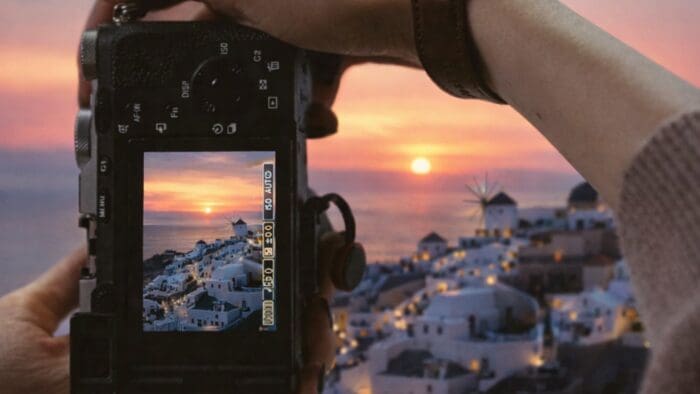
Santorini’s caldera is full of natural foreground elements: terrace railings, potted plants, wine glasses on a table, iconic blue domes. Include a foreground element two to three meters from your camera to create depth and scale.
This is one reason a terrace setting, such as the clifftop vantage point at Santorini Sunsets, gives you a visual advantage over a crowded public viewpoint. The dining tables, candles, and terrace details all serve as rich foreground interest without requiring you to search for them.
Shoot Silhouettes
In the final minutes of sunset, stop down to f/16 and expose for the bright sky. Subjects in the foreground, people, windmills, domes, boats, become dramatic black silhouettes against a fiery background. This technique produces some of the most emotionally powerful sunset images.
Include the Sun’s Starburst
At f/16 or f/22, a point light source like the setting sun creates a starburst effect. Position the sun so it partially hides behind a dome, a chimney, or a terrace edge, then shoot. The partial obstruction of the sun enhances the starburst and prevents sensor flare from washing out your image.
Vary Your Focal Length
Shoot the same scene at 24mm, 50mm, and 135mm in sequence. The wide shot gives context; the telephoto compresses layers and makes the sun appear dramatically large relative to the landscape. Most travelers only use one focal length and miss two-thirds of the story.
Best Sunset Photo Spots in Oia
For a full breakdown of the best sunset locations in Oia and across Santorini, read our dedicated guide: From Castle to Caldera: 10 Sunset Photo Spots You Can’t Miss.
Here is a brief rundown with a photography perspective:
Oia Castle (Kastro)
The most iconic Santorini sunset photo spot, but also the most crowded. Arrive 90 minutes before sunset to secure a position along the ruins. Use a telephoto lens to isolate the windmills against the orange sky without crowds in the frame.
Caldera Terrace Dining Spots
Restaurant terraces along Oia’s caldera offer an elevated vantage point away from the crowd crush. At Santorini Sunsets, the clifftop position at the highest point of the caldera gives unobstructed 360-degree views. Shoot freely between courses and use the terrace elements, tables, glassware, candles, as part of your composition. The Bites & Bubbles lounge level is a particularly relaxed spot to shoot the sky while holding a drink.
Ammoudi Bay
Walk down from Oia for a sea-level perspective. The cliffs tower above, the boats sit still in the harbor, and the sunset reflects across the water. Bring a wide-angle lens and work the reflection and the layered volcanic rock in your composition.
Skaros Rock, Imerovigli
A 20-minute hike from Imerovigli. Fewer crowds, raw dramatic terrain, and unobstructed caldera views in every direction. The extra effort rewards you with images that look nothing like the standard Oia postcard.
Smartphone Photography Tips for Santorini Sunsets
You do not need a dedicated camera to come away with strong images.
- Use Pro or Manual mode: Control ISO, shutter speed, and white balance directly. Set white balance to Daylight (5500K) to preserve warm tones.
- Enable gridlines: Use them to align the horizon and apply the rule of thirds.
- Lock exposure and focus separately: Tap and hold on your subject to lock focus, then slide the exposure wheel to protect highlights.
- Shoot in RAW (where available): iPhones (via Apple ProRAW) and many Android flagships support RAW capture. Use it.
- Use Night Mode sparingly during golden hour: It tends to average out the dynamic tones you want to keep punchy and distinct.
- Shoot in portrait orientation too: Many sunset social media posts perform better vertically. Capture both.
Post-Processing: Making Your Santorini Sunset Shine
Great processing starts with a well-exposed RAW file. These are the key adjustments:
- Recover highlights: Drop Highlights by 60 to 100 to bring back sky detail.
- Open shadows: Raise Shadows by 30 to 60 to lift the caldera cliffs and foreground.
- Adjust white balance: Shift Temp slightly warmer (400–600K above your shot WB) to enhance the golden tone without going orange.
- Increase Clarity and Texture: Adds micro-contrast to the volcanic rock and whitewashed walls.
- Use a gradient filter: Apply a graduated filter to the sky, reducing exposure and lifting blues separately from the warm foreground.
- Reduce noise carefully: If you shot at ISO 800 or above, use Lightroom’s AI Denoise or Topaz DeNoise to clean the image without losing detail.
Avoid over-saturation. Santorini’s natural colors at golden hour already look almost unreal. Heavy-handed color edits make the image look processed rather than present.
Practical Tips for the Day of Your Shoot
Planning matters as much as equipment.
- Scout the location in the morning: Walk your chosen spot without crowds. Identify your composition, check for obstacles, and plan your positioning before the sun-chasing crowds arrive.
- Arrive at least 60 minutes early: This is non-negotiable for busy viewpoints like Oia Castle. For restaurant terraces, confirm your reservation secures the right table.
- Dress for the wind: Santorini’s caldera generates strong, unpredictable gusts at sunset. Secure your tripod with a weight bag and keep lens caps tethered.
- Watch behind you: As the sun drops, the eastern sky fills with pink and purple reflected light that most photographers miss entirely. Turn around.
- Stay after sunset: The “blue hour,” the 20 to 30 minutes after the sun disappears, produces some of the most serene and color-rich images of the day. Commit to it.
- Back up your cards the same night: Cards fail. Santorini memories are not worth risking.
Where to Stay Positioned: Dining vs. Public Viewpoints
This is a practical decision every photographer faces in Oia.
Public viewpoints like Oia Castle give you access and dramatic scale, but they also give you elbow-to-elbow crowds, jostled tripods, and sometimes blocked shots. They are free and iconic, and with proper timing, still excellent.
Restaurant terraces offer a different photographic experience. You gain elevation, unobstructed sightlines, and the freedom to move and compose without fighting for space. At Santorini Sunsets, the terrace level at the highest caldera point in Oia combines these advantages with slow dining, local wine, and a team that understands the rhythm of golden hour. You photograph; then you eat; then you photograph the blue hour.
The Sunsets Terra reservation-only level and the walk-in Bites & Bubbles lounge both face the caldera, giving you options depending on whether you prefer an intimate dining experience or a more relaxed, social atmosphere.
If you are serious about your Santorini sunset images, pairing a great location with a great experience is a decision you will not regret.
Every Second Counts, So Prepare
The Santorini sunset does not wait. The sky shifts from gold to pink to deep violet in the span of 20 minutes, and the moment you spend fumbling with settings is a moment you cannot get back.
The photographers who come home with extraordinary images are not always the ones with the most expensive gear. They are the ones who arrived early, understood the light, composed with intention, and stayed through the blue hour.
Bring the right equipment, dial in your settings before the sky peaks, choose your location wisely, and give yourself room to enjoy what is in front of you.
Some of the best Santorini sunset photos ever taken came from a smartphone on a restaurant terrace, held by someone who simply paid attention.
Complete Your Oia Experience
After discovering the must-see attractions in Oia Santorini, end your day with sunset drinks or a memorable dinner overlooking the caldera at Santorini Sunsets.
FAQ: Santorini Sunset Photography
What is the best camera setting for a Santorini sunset?
Start with ISO 100–200, f/8 to f/11, and a shutter speed around 1/125s for the first 30 minutes of golden hour. As light fades, raise ISO to 400–800 and slow your shutter to 1/30s or longer (use a tripod). Always shoot in RAW for maximum editing latitude.
What time is the best light for sunset photography in Santorini?
The best light begins around 45 to 60 minutes before the official sunset time. In summer (June to August), that means arriving at your location by around 7:45 PM. Check exact sunset times for your travel dates on TimeandDate.com.
Do I need a tripod for Santorini sunset photography?
A tripod is not essential during the bright golden hour window, but it becomes very helpful in the final 15 minutes of sunset and during blue hour, when shutter speeds slow to the point where handheld shooting creates camera shake. Compact travel tripods are ideal for Santorini’s paths.
What is the best lens for Santorini caldera views?
A 24–70mm f/2.8 zoom covers the widest range of compositions. Add a 16–35mm for expansive caldera panoramas and a 70–200mm to compress the sun against Oia’s blue domes and windmills.
Can I photograph the Santorini sunset from a restaurant?
Yes, and it is often a better experience than a crowded public viewpoint. Clifftop restaurants in Oia, including Santorini Sunsets, offer unobstructed caldera views from elevated terraces. You have more freedom to move, compose, and shoot without fighting the crowd.
What is the best spot to photograph the Santorini sunset in Oia?
Oia Castle is iconic but crowded. For a more manageable shooting experience with equally stunning views, caldera terrace restaurants at the highest point of Oia, Skaros Rock in Imerovigli, and Ammoudi Bay for sea-level shots are all excellent. Read our full guide to 10 Santorini sunset photo spots.
Should I shoot in RAW or JPEG for Santorini sunsets?
Always shoot RAW. Santorini sunsets have a wide dynamic range, bright sky and dark cliffs, that JPEG cannot capture in a single exposure. RAW files give you the editing flexibility to recover both highlights and shadows without losing quality.
Is a smartphone enough for Santorini sunset photography?
A modern flagship smartphone, iPhone 16 Pro, Samsung Galaxy S25 Ultra, Google Pixel 9 Pro, is capable of producing stunning results at sunset. Use Pro or Manual mode, shoot in RAW where available, and set white balance manually to preserve the warm tones.