
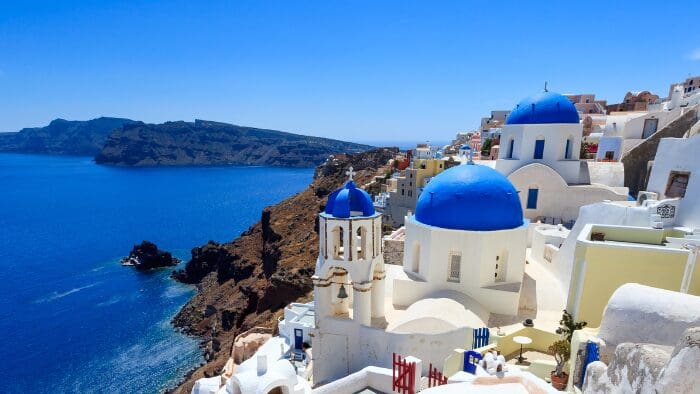
You come for the caldera view. Sure. But what you take home isn’t the view itself. It’s the moment you remember in your body: the warm light on the white walls, the sound of forks on plates, the hush before the sun drops, and that strange little feeling that your day has a storyline.
That’s the experience economy of Santorini in a nutshell. And Oia is its clearest example.
This guide breaks down how Oia became a destination for moments, not just views and how you can plan your trip so it feels intentional (instead of crowded, rushed, and slightly chaotic).
What “Experience Economy” Means in Santorini Terms
It’s not about buying things. It’s about collecting memories.
In an experience economy, people don’t just pay for products or services. They pay for how a place makes them feel and how that feeling fits into a personal story.
That is not a theory anymore. It’s how travel works now.
A 2024 travel industry report notes that consumers are prioritizing experiences over goods, with 88% saying they planned to spend the same or more on experiences in 2024 (vs. 2023). Travel and tourism-related experiences were the top category, followed by food-related experiences.
Why Oia fits this shift perfectly
Oia delivers “high-emotion” travel in a very compact space:
- Instant beauty (you don’t need effort to find it)
- Built-in rituals (sunset timing, dinner timing, photo timing)
- A sensory setting (light, wind, sea, wine, music, texture)
- Social proof everywhere (you feel like you’re in the frame already)
And yes, it also means Oia can feel like a theme park if you show up unplanned. We’ll fix that.
Why Oia Became a “Moments Destination” (Not Just a Place)
The landscape does half the work
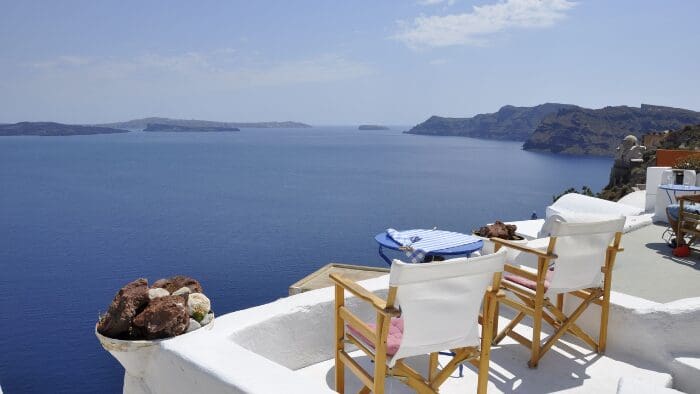
Oia isn’t flat. It’s vertical. That matters.
The caldera cliffs create:
- Layered views (sea + volcanic curve + sky)
- Natural amphitheaters for sunset watching
- Terraces that feel like private “stages”
This geography turns simple activities, like having a drink, into an “event.”
The architecture is basically a lighting filter
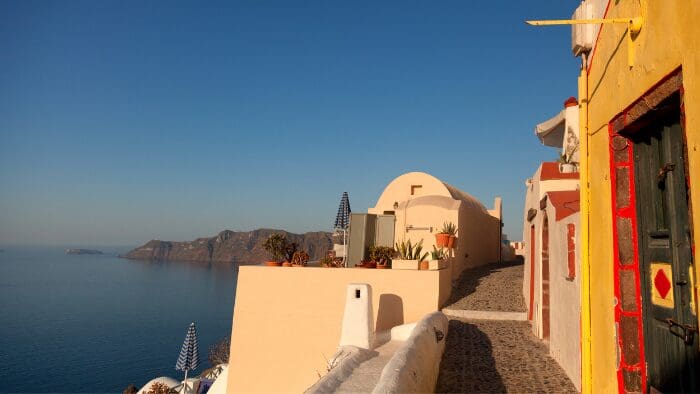
Whitewashed walls aren’t just aesthetic. They bounce sunset light back into the streets. You’re walking inside a natural reflector. That’s why even a random alley can look cinematic at golden hour.
The village is small, which intensifies everything
In big destinations, moments spread out. In Oia, everything overlaps:
- The famous photo spots
- The boutique hotels
- The cliffside walkways
- The dinner terraces
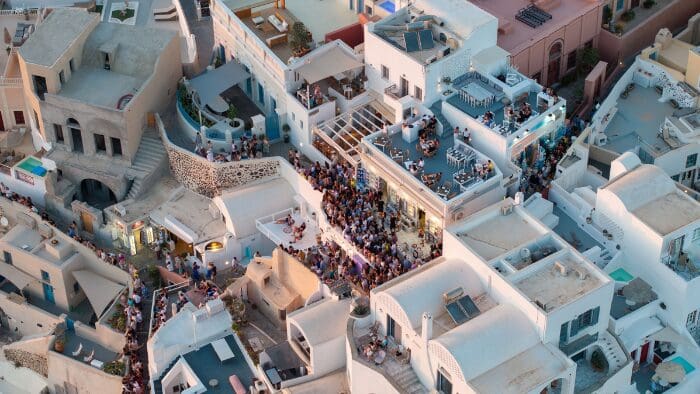
It creates density. It feels exciting. It also creates pressure. Which is why planning matters more here than it does in most places.
The Sunset Ritual: Oia’s Most Valuable “Product”
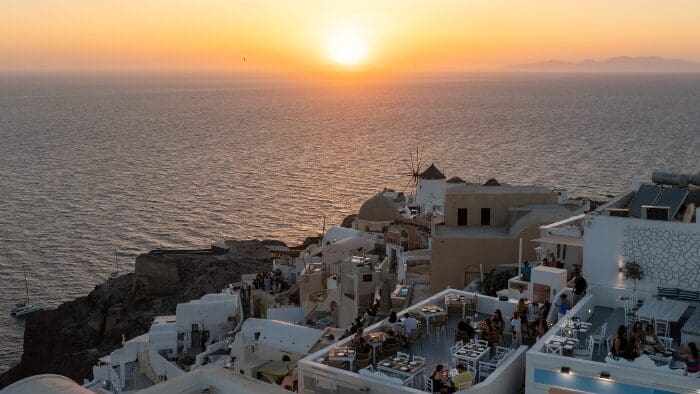
Sunset in Oia is treated like a daily performance
If you’ve been, you know the vibe:
- People gather early
- Cameras come out
- Conversations get quieter
- Then the light changes fast, and everyone acts like they’re seeing color for the first time (they kind of are)
This ritual is a core reason “Santorini sunset” searches are so high-intent. People aren’t casually curious. They’re planning a once-in-a-lifetime evening.
Sunset fits a bigger travel trend: “Noctourism”
Travelers are increasingly planning around evening experiences cooler temperatures, night markets, stargazing, late museum hours, and sunset-first itineraries.
Booking.com’s 2025 travel predictions highlight this shift, including that over 60% of surveyed travelers were considering destinations with limited light pollution for night-sky experiences, and 61% wanted to spend less time in the sun. In Oia, that trend translates into something simple: Sunset becomes the anchor point for the whole day.
Food as Theater: How “Oia Restaurant Santorini” Became a Search Intent
People don’t Google “oia restaurant santorini” because they’re hungry. They Google it because they want a very specific kind of night.
They want:
- The view
- The timing
- The mood
- The “we did it” feeling
- And yes, food that’s actually worth the price tag
What makes a sunset dinner feel like a “moment”
A real experience-driven dinner has a few markers:
- Pacing (you’re not rushed; the meal matches the light)
- A clear sequence (aperitif → starter → main → dessert, timed with sunset)
- A view you don’t have to fight for
- Service that feels calm and precise (not frantic)
This is why the phrase “sunset view Oia restaurant” is more than SEO. It’s a behavior. People are literally planning their vacation evenings around a table angle.
Quick tip: treat dinner like a reservation for a view
If the view is your goal, don’t leave it to chance.
Do this instead:
- Book a table 30–45 minutes before sunset
- Ask for a west-facing terrace if possible
- Choose a place that doesn’t require you to stand shoulder-to-shoulder at a lookout afterward
This is how you avoid the classic Oia mistake: finishing dinner and realizing you missed the best 12 minutes of color.
Sunset Bars, Sparkling Sips, and the “Pre-Dinner Moment”
Not everyone wants a full multi-course meal. Some people want the energy.
That’s where the sunset bar culture comes in. It’s a lighter format, but the same goal: sit, sip, watch the sky change, feel like you’re exactly where you’re meant to be.
The “sunset Oia” vibe is real
There’s a reason so many travelers build the evening around:
- Bubbly cocktails
- Local wine
- A small plate or two
- And a seat that faces the horizon
It’s a low-commitment way to get a high-reward memory. And honestly, it’s a smart move if your schedule is tight.
The Hidden Driver: Oia’s Crowds Made “Planned Moments” More Valuable
Here’s the part people avoid saying out loud: Oia is popular enough that spontaneity can backfire.
Santorini’s visitor pressure is intense
According to an English-language report from Greece’s OT publication, Santorini welcomed 800 cruise ships in 2023, bringing nearly 1.3 million passengers, and on peak days up to 17,000 cruise visitors can disembark, adding pressure to areas like Fira and Oia.
You don’t need to be anti-tourist to see the problem. You just need to stand in a sunset crowd and realize you’re not actually enjoying it.
What happens in an experience economy under crowd pressure
When a destination gets crowded, experiences split into two lanes:
- Free-but-chaotic moments (standing-room sunsets, rushed service, noisy streets)
- Paid-but-curated moments (reservations, terraces, timed pacing, calmer settings)
That’s the experience economy in action. You’re not paying for “better food.” You’re paying for a better memory.
Where Santorini Sunsets Fits In (Subtle, But Real)
If you want one clean example of how Oia turns moments into a designed experience, look at how some venues build the night around the sunset itself.
At Sunsets Terra (part of Santorini Sunsets), the concept is slow-paced dining with 360° caldera views, designed for the sunset hour and reservation-only which is basically the opposite of fighting for space at a viewpoint.
And if you’re not in a full dinner mood, Bites & bubbles by Sunsets is positioned as a more casual lounge style experience with sunset views and a walk-in approach.
If your goal is a calm, seated sunset moment, it’s worth booking a terrace table in advance, especially in peak season.
Sustainability: The Experience Economy Has a Responsibility Problem
A destination built on “moments” can burn out if it’s not managed well. That matters for travelers too, not just locals.
Travelers care more than they used to
The same travel report that highlights the experience economy also points to sustainability as a major concern, including high agreement that sustainable travel is important.
In plain terms: people want beautiful places to stay beautiful.
How to travel Oia in a way that doesn’t feel gross
No guilt-trip. Just practical choices:
- Choose experiences that use local ingredients and local staff
- Avoid peak-hour “rush” itineraries (you’ll enjoy more and stress less)
- Walk when you can (Oia is better on foot anyway)
- Spend intentionally: one great meal + one great tasting beats five mediocre stops
- Respect the village rhythm: quiet streets are part of the magic, don’t be the loudest person in them
How to Plan an Experience-First Day in Oia (Without Overplanning)
You don’t need a strict schedule. You need an anchor point and a few smart windows.
A simple “moments” itinerary you can actually follow
|
|
|
|
|
|
|
|
|
|
|
|
|
|
|
|
|
|
|
|
|
|
|
|
The only rule that really matters
Pick your sunset plan first.
Then build everything else around it.
That’s how you get a day that feels like a story instead of a checklist.
How to Spot a “Real” Experience (And Skip the Tourist Traps)
Not every “experience” is worth it. Some are just overpriced choreography.
Use this quick checklist
A moment is usually worth paying for if it has:
- A clear setting advantage (view, privacy, design, access)
- A thoughtful pace (not rushed, not chaotic)
- A local anchor (ingredients, wine, craft, people, history)
- A memory hook (sunset timing, sensory detail, personal touch)
If it’s missing all of those, you’re probably paying for branding. And you deserve better than that.
Oia Isn’t Just a View. It’s a Feeling You Can Plan For.
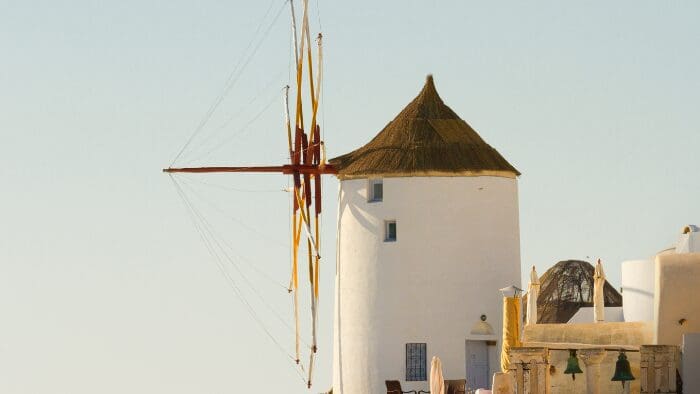
Oia became the poster child of Santorini because it turns simple things into high-emotion moments: a glass of wine, a terrace seat, the last light on the caldera.
That’s the experience economy. And it’s not going away.
If you want Oia to feel magical (instead of stressful), plan around one or two anchor experiences, especially sunset. Book early. Arrive calm. Sit down. Let the island do what it does best.
And if one of those anchors is a sunset dinner, a seated terrace experience, like Santorini Sunsets, is an easy way to make the moment feel yours, not shared with 400 elbows.
FAQ: The Experience Economy of Santorini & Oia
1) What is the experience economy in travel?
It’s the shift from buying “things” to paying for memorable moments like sunset dinners, tastings, private tours, and design-led hospitality.
2) Why is Oia so famous for sunset?
Because the village sits high on the caldera with west-facing views, and the white architecture amplifies golden-hour light. It’s a built-in stage for sunset.
3) How can I enjoy Oia without the worst crowds?
Go early in the day, take breaks midday, and reserve your sunset plan (dinner or drinks) so you’re not fighting for space at the last minute.
4) Is a sunset dinner in Oia worth it?
It can be, if it’s timed and seated properly. You’re paying for pacing, view access, and the feeling of being present during golden hour.
5) What’s the difference between a sunset restaurant and a sunset bar in Oia?
A sunset restaurant is usually a full dining experience with multi-course pacing. A sunset bar is more casual, drinks and small bites, with the same view-focused payoff.
6) How do I choose an “experience” that supports the island?
Look for places that highlight local ingredients, local wine, and respectful pacing and avoid rushed, high-volume setups that feel disposable.